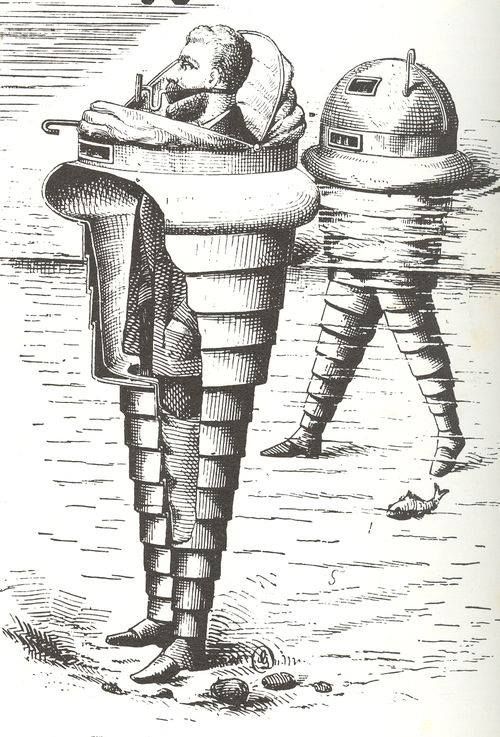
In 1877, Scientific American published an illustration of an invention by Traugott Beck: a life preserver designed not simply to keep a person afloat, but to enclose them within a small, self-contained world.
At first glance, the device appears almost comical. A figure stands upright in the sea, encased in a rigid, buoyant structure that rises above the waterline like a floating shell. The upper section forms a protective dome, allowing the wearer to keep their head and arms inside, shielded from waves. A small window offers visibility when the cover is closed, and a curved pipe provides air. Below, waterproof trousers and reinforced boots extend downward, protecting the body from rocks and, as the original description notes, from “voracious fish.”
But beneath its peculiar appearance lies a serious intention. This is a machine for survival, designed at a time when the sea was both a route and a risk, when technological solutions sought to mediate between the human body and an unpredictable environment.
What is striking is how complete the enclosure is. Unlike a simple life vest, which supports the body while leaving it exposed, Beck’s design creates a boundary. It does not merely assist the swimmer; it transforms the human into something else, part vessel, part occupant. The wearer no longer floats in the water, but exists within a floating system.
There is a certain logic to this. If the sea is hostile, then survival may require separation. Protection becomes insulation. The world is kept at a distance.
And yet, the image carries an ambiguity. The figure is safe, but also isolated. Movement is restricted. Perception is filtered through a small window. Breathing depends on a tube. The device preserves life, but in doing so, it reshapes the experience of being alive.
Seen from today, the invention feels both distant and familiar. We no longer build such contraptions for everyday survival at sea, but the idea of enclosing the body within protective systems persists. From diving suits to spacecraft, from protective gear to personal technologies, we continue to design interfaces that mediate between ourselves and the environments we inhabit.
Beck’s life preserver belongs to an earlier moment in that trajectory, when solutions were still visible, mechanical, and unapologetically physical. Its materials, like sailcloth, metal tubes, reinforced boots are not hidden. Its function is legible, even if its form borders on the surreal.
There is also, quietly, a kind of imagination at work. Not just how to survive, but how to remain present while doing so. The window, the breathing pipe, the ability to move one’s arms—these are not only technical features, but gestures toward continuity. Toward maintaining a relationship with the world, even from within a protective shell.
In this sense, the device is less about escaping danger than about negotiating it.
It asks a question that still resonates: how much distance from the world do we need in order to remain within it?
Traugott Beck, the inventor behind this unusual device, was likely a German-born immigrant working in Newark, New Jersey during the late 19th century. Thought to be Traugott Ernst Beck (1828–1888), he belonged to a generation of inventors shaped by the industrial expansion of American cities, places where experimentation, practicality, and ambition often intersected.
His life preserver, published in Scientific American in 1877, reflects this context. It was not only a protective suit but a self-contained survival system, constructed from waterproof sailcloth and metal tubes, and even designed to carry provisions for extended periods at sea. Beck’s inventive activity was not limited to maritime safety; he also held patents for other mechanical improvements, including a design for spurs, suggesting a broader engagement with everyday technologies.
Today, his work survives less as a widely adopted solution and more as part of a visual and cultural archive of Victorian invention, an era in which bold, sometimes eccentric ideas attempted to engineer safety in a world still deeply exposed to risk.
Radiona.org