In 1930, long before commercial aviation became routine and decades before humanity would leave Earth’s atmosphere, British illustrator W. Heath Robinson imagined what the skies of the future might look like.
His illustration Aerial Inventions A.D. 2000, created for the book The Wonder Book of Inventions, offers a playful, intricate, and deeply human vision of technological progress. It is not a prediction in the scientific sense—but something far more interesting: a cultural snapshot of how people once dreamed about the future.
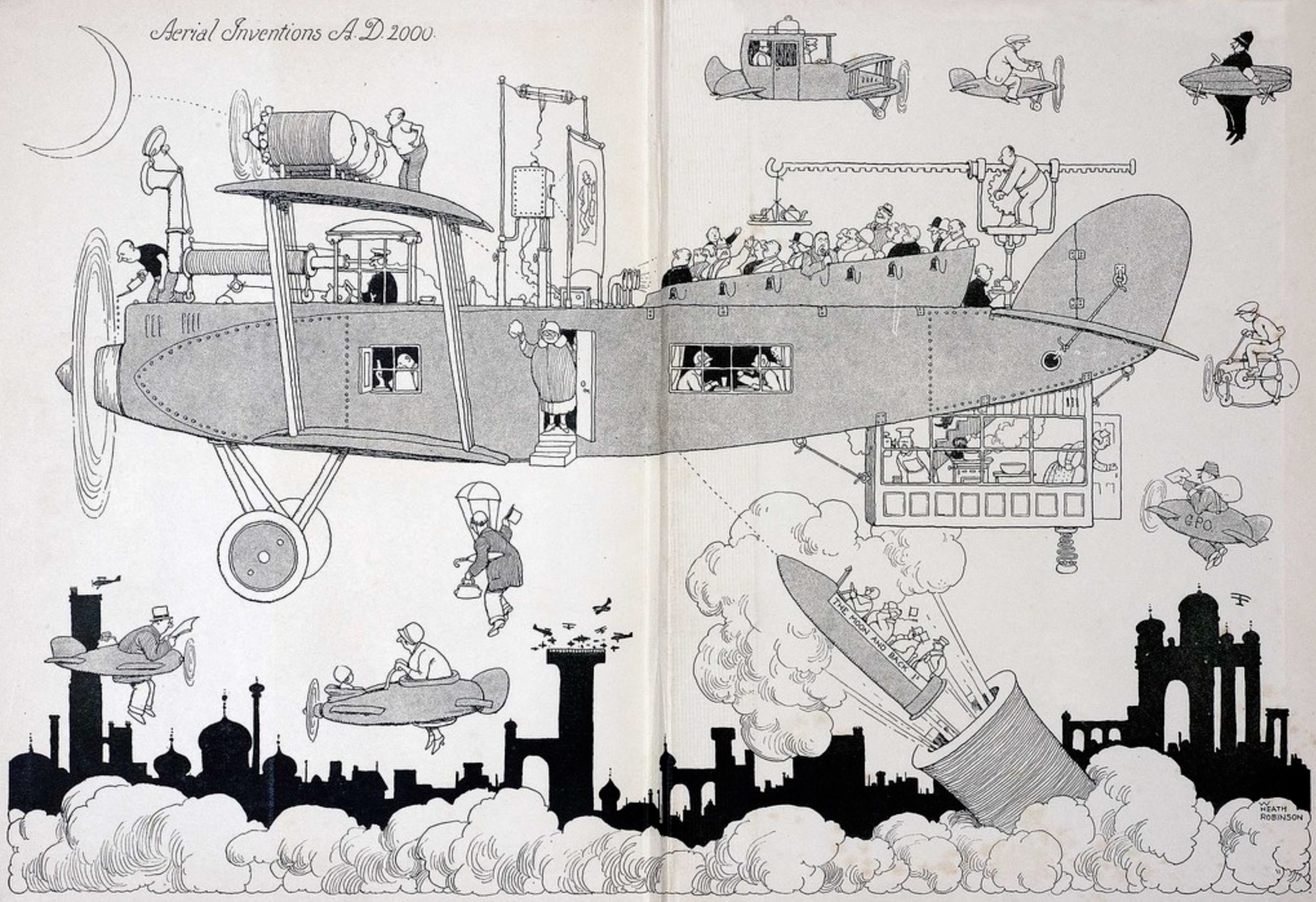
W. Heath Robinson, Aerial Inventions A.D. 2000, 1930. Public domain.
A Sky Full of Contraptions
At first glance, the image is dense and almost overwhelming. A large, hybrid flying machine dominates the scene, part aircraft, part house, part social club. It carries passengers, machinery, observation decks, and what appears to be a fully functioning domestic interior.
Surrounding it, the sky is alive with individual flying devices like personal flying pods, bicycle-like airborne machines, floating chairs and small propeller-driven crafts and even airborne leisure vehicles that seem designed as much for comfort as for travel
Below, a stylized cityscape stretches across the horizon, its architecture evoking both the exotic and the industrial—suggesting a world that is simultaneously futuristic and rooted in early 20th-century imagination.
Technology as Theatre
What makes Robinson’s work so distinctive is not just the invention, but the presentation of invention.
Every mechanism is exaggerated, gears are oversized, levers are overly elaborate and systems appear unnecessarily complex
This is the essence of a “Heath Robinson machine” - a term that has become synonymous with absurdly complicated engineering solutions. His devices are not about efficiency; they are about process, spectacle, and the joy of making things.
In this illustration, technology becomes theatre. People are not just transported, they participate. They climb, adjust, observe, and interact. The machine is not invisible infrastructure; it is a lived environment.
A Human-Centred Future
Unlike many modern visions of the future often sleek, minimal, and automated, Robinson’s world is crowded, tactile, and social.
People gather on decks, lean out of windows, wave and watch. The flying machine is not isolating; it is communal. Even the chaos feels friendly.
There is also something deeply reassuring in this vision: technology does not replace people, it does not become invisible and it remains understandable, even if comically complex
This reflects a moment in history when machines were still mechanical, visible, and graspable before the abstraction of digital systems.
Humor as Critique
Robinson’s work is often humorous, but never trivial.
The absurdity of his inventions gently questions the idea of progress itself. Are we building better systems or just more complicated ones? Is innovation always meaningful, or sometimes just elaborate?
In Aerial Inventions A.D. 2000, the future is not efficient, it is whimsical, slightly chaotic, and unmistakably human.
Looking Back from Our Present
As we have passed the year 2000 long time ago, Robinson’s vision feels both distant and surprisingly relevant.
We did not build flying living rooms or airborne bicycles for everyday use. Instead, we created invisible networks, satellites, and digital infrastructures that shape our lives in ways he could not have imagined.
And yet, his illustration still resonates especially today, when there is a renewed interest in DIY culture, maker communities, visible and understandable technology, as well as slower, more human-centred design
In many ways, his imagined future aligns more closely with contemporary alternative tech cultures than with mainstream industrial design.
Why It Still Matters
Aerial Inventions A.D. 2000 reminds us that the future is not just something to be engineered, it is something to be imagined.
And imagination, especially playful and critical imagination, is essential.
Robinson didn’t try to predict the future.
He made it visible as a question.
What kind of world do we actually want to build?
Radiona.org